

Sumud’s Position on Two States vs One State: A Rights-Based Approach
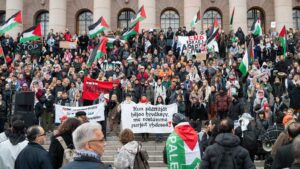
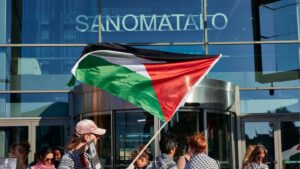
26/11/2025, 15:52Photo: Hannu Häkkinen
Summary: As there is no agreement among Palestinians on the issue of two states versus one state, Sumud does not take a position on it. We note that the establishment of a Palestinian state only on the Occupied Palestinian Territories would not realise all Palestinian rights. Sumud strives for justice and equity for all Palestinians via decolonisation.
Sumud wants to end Israeli colonialism, apartheid, occupation, and genocide. We work for the realisation of Palestinian human and political rights in a process of decolonisation.
As a solidarity movement, Sumud bases its positions on the views of Palestinian civil society and international law. Currently the most representative body of Palestinian civil society is the BDS National Committee (BNC), which coordinates the BDS movement and updates its ethical guidelines.
We thus follow the rights-based approach of the BDS movement. The BDS call issued by the BDS movement in 2005 demands that Israel ends the occupation, gives equal rights to Palestinian citizens of Israel, and allows Palestinian refugees to return home.
Like the BNC, Sumud does not take a position on the details of the political arrangement by which these rights are realised. However, any acceptable solution has to follow international law and guarantee the rights of all people who live in or have been ethnically cleansed from Palestine, and have the support of Palestinians.
The political arrangement that is nominally most widely supported by states and international organisations, including Finland, the EU and the UN, is the two-state model. This means the establishment of a Palestinian state alongside Israel. It is not a rights-based approach and would not realise all Palestinian rights.
Officially, the Palestinian Liberation Organisation (PLO) declared the independence of the State of Palestine already in 1988, on the area of Gaza and the West Bank, including East Jerusalem, collectively known as the Occupied Palestinian Territories (OPT). By May 2025 the State of Palestine had been recognised by more than three quarters of United Nations member states (147 out of 193). However, in practice the state does not exercise sovereignty anywhere, as Israel has occupied these territories since 1967, and continues to deny Palestinians their right to self-determination, including by building illegal settlements.
The official representatives of the State of Palestine seek the end of the Israeli occupation on the OPT, including the removal of all Israeli settlements. The International Court of Justice, the principal judicial organ of the UN, in July 2024 issued an advisory opinion according to which the occupation is illegal and Israel has to end it “as rapidly as possible”, including by withdrawing all settlers. Following the ICJ opinion, the UN General Assembly voted in September 2024 that Israel must end the occupation within 12 months.
No Israeli government has ever agreed to end the occupation of the OPT and allow the establishment of a Palestinian state. Instead, Israel has spent decades colonising these areas and making them economically dependent on Israel. This has involved a systematic policy of integration and annexation into Israel, coupled with segregation and de-development. In Gaza this has culminated in the genocidal wholesale destruction of people, infrastructure, and nature.
Even if a Palestinian state were to be established on the OPT, this would not realise all Palestinian rights. It would not guarantee equality for Palestinian citizens of Israel, nor the possibility of Palestinian refugees to return to their homes, most of which are in what is now Israel. The two-state solution also overlooks the interwoven nature of the colonial apartheid regime that the Zionist movement has established over all of Palestine – meaning in Israel and on the OPT.
The integrated nature of this apartheid regime has been emphasised in the reports of Amnesty International, Human Rights Watch and Israel’s most respected human rights organisation B’Tselem, following the work of the Russell Tribunal on Palestine. Its roots in Zionist settler colonialism have been highlighted by Palestinians for a long time, including recently by Al-Haq and other Palestinian human rights organisations.
Another possibility that is increasingly discussed is the one-state solution. It means giving all people who live in Palestine or who have been exiled from there equal rights in one democratic state. This is sometimes called the South African model, after the solution adopted there at the end of the apartheid regime in 1994. A version of it was outlined by the PLO in Yasser Arafat’s speech to the United Nations in 1974, where he called for one democratic state. The one-state solution has been promoted by the Palestinian, Israeli and other signatories of the 2007 One State Declaration. It is also pursued by the One Democratic State Campaign, who have outlined ten principles for decolonising the current apartheid state and replacing it with a democratic state.
As there is no agreement among Palestinians on the issue of two states versus one state, Sumud does not take a position on it, except to note that the establishment of a Palestinian state only on the OPT would not realise all Palestinian rights.
We unite the rights-based approach with decolonisation. Palestinians are the Indigenous people of Palestine, and their struggle is a fight against ongoing colonial violence. Justice and equity must be upheld for all Indigenous peoples, including Palestinians. In Palestine this requires dismantling the settler-colonial regime that the Zionist movement has set up and replacing it with a just and equitable system.
Sumud emphasises the notion of equity instead of equality. Equity acknowledges historical injustices and centres the lived experiences of the oppressed, especially indigenous peoples. We reject conditional self-determination and call for reparations as part of justice. Any liberation framework must affirm that Palestinians are the rightful owners of their homeland and recognize their enduring struggle through decades of the continuing Nakba (the ethnic cleansing and colonial dispossession carried out by Israel).
Sumud welcomes people who support Palestinian liberation, regardless of whether they support one state, two states, no states, confederation, another arrangement, or have no view on this issue. What unites us is commitment to justice, equity, and decolonisation.